Choosing the Right Water Treatment System for Your Home

Water is one of those everyday essentials that you don’t really appreciate until something goes wrong. Maybe your showerhead is covered in white scale, your drinking water has an odd taste, or your glassware comes out of the dishwasher looking cloudy. These problems can be frustrating, but they also offer a useful clue: your home’s water may need a closer look.
The good news is that water treatment is no longer a one-size-fits-all decision. There are systems designed for specific concerns, from hard water to unwanted substances in drinking water. The trick is understanding what each option does—and choosing based on your actual water quality rather than a flashy sales pitch.
Start by Understanding Your Water
Before shopping for equipment, take a moment to identify the problem. Is the issue mainly mineral buildup? Does the water smell like chlorine? Are you concerned about the quality of water coming from a private well? Or are you simply looking for better-tasting drinking water?
A water test can help answer these questions. It may measure hardness, pH, iron, chlorine, total dissolved solids, and other relevant characteristics. Some concerns require more specialized laboratory analysis, particularly when you need to investigate specific contaminants.
This step matters because different treatment systems solve different problems. A filter designed to improve taste won’t necessarily soften hard water, and a softener isn’t intended to remove every contaminant. Knowing the starting point makes the rest of the process much less confusing.
What Do Water Softeners Actually Do?
For households dealing with hard water, water softeners can make a noticeable difference. Hard water contains minerals, primarily calcium and magnesium, that can form scale inside plumbing and appliances.
Traditional water softeners generally use an ion-exchange process. As water passes through the system, hardness minerals are exchanged for sodium or, in some systems, potassium ions. The result is water that is less likely to create mineral deposits.
You may notice practical benefits such as less scale around faucets, improved soap lather, and fewer deposits in water heaters or shower fixtures. Laundry may also feel different, particularly if hard water has been affecting how detergents work.
However, softeners aren’t designed to solve every water-quality issue. They don’t function as universal drinking-water filters, and they require regular maintenance, including regeneration and replenishment of the appropriate salt or treatment material. If sodium levels are a concern, discuss alternative options with a qualified professional.
When Reverse Osmosis Makes Sense
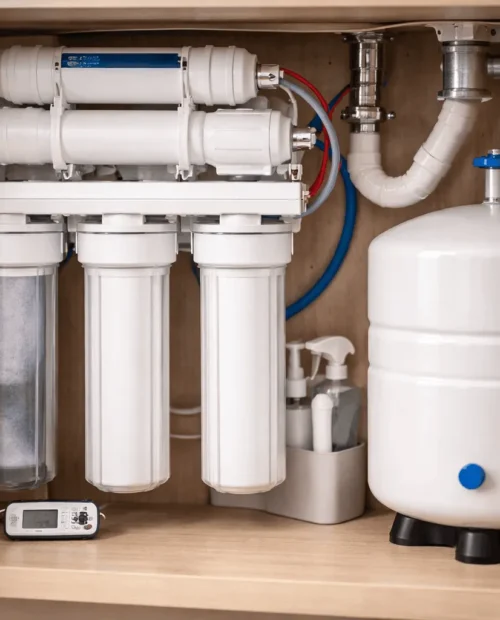
If your main concern is the quality and taste of drinking water, a reverse osmosis system may be worth considering. Reverse osmosis drinking water systems use a semipermeable membrane to reduce many dissolved substances from water.
In a typical setup, water passes through several stages. Pre-filters help protect the membrane, the reverse osmosis membrane reduces selected dissolved impurities, and a final filter may improve taste. Some systems also include a storage tank or a dedicated faucet for treated water.
Reverse osmosis can be useful for reducing certain substances, but its performance depends on the specific system, water conditions, and maintenance. It isn’t accurate to assume that every RO system removes every contaminant.
These systems also produce wastewater during operation and may require adequate water pressure. Filter and membrane replacement is essential, too. If you’re considering RO, ask what the system is certified to reduce and whether the design suits your household’s daily drinking and cooking needs.
Whole-Home Treatment: Is It Necessary?
Some homeowners want water treatment at every tap, not just the kitchen sink. That’s where whole house water treatment becomes relevant. These systems are designed to treat water as it enters the home or at another central point, depending on the setup.
A whole-home system may combine technologies such as sediment filtration, activated carbon, water softening, or other treatment stages. The right combination depends on the water source and the concerns identified during testing.
For example, a whole-home carbon filter may help reduce certain tastes and odors throughout the house. A softener may address hardness before water reaches showers, laundry machines, and water heaters. In some cases, additional treatment may be needed for specific contaminants.
The advantage is convenience: treated water is available across the property. But whole-home systems can involve higher upfront costs, larger equipment, and ongoing maintenance. If your concern is limited to drinking water, a point-of-use system may be more practical than treating the entire supply.
Comparing Point-of-Use and Whole-Home Systems
The choice between point-of-use and whole-home treatment often comes down to what you need and where you need it.
A point-of-use system, such as an under-sink filter or RO unit, focuses on one faucet. It’s often suitable for drinking and cooking, especially when the main concern involves taste or specific dissolved substances.
A whole-home system treats water for multiple household activities. This may be more appropriate when hard water, sediment, or unpleasant odors affect showers, appliances, laundry, and other fixtures—not just drinking water.
Neither approach is automatically better. A household with hard water and a separate drinking-water concern may benefit from combining a softener with a kitchen RO system. Another home may only need a targeted filter. Testing and professional advice can help prevent unnecessary equipment purchases.
Don’t Ignore Installation and Maintenance
A water treatment system is only as useful as its installation and upkeep. Even a well-designed unit can perform poorly if it’s incorrectly sized, improperly installed, or neglected over time.
Before buying, ask about water pressure requirements, available installation space, drainage, electrical needs, and replacement filter costs. Find out how often the system needs servicing and whether the company provides maintenance support.
It’s also important to understand the difference between a system’s advertised capabilities and its tested performance. Look for relevant certifications and documentation where available. A trustworthy provider should explain the equipment clearly rather than making broad promises.
Keep an eye out for changes in water taste, pressure, color, or odor after installation. These changes may indicate that a filter needs replacement or that the system requires inspection.
Think About Long-Term Value
The cheapest system isn’t always the most economical choice, and the most expensive one isn’t automatically the right answer. Consider the full cost of ownership, including installation, replacement filters, salt, electricity, water usage, and servicing.
A system that addresses the actual problem can save money by reducing scale-related maintenance, protecting appliances, or avoiding repeated purchases of bottled water. But buying equipment that doesn’t match your water conditions can have the opposite effect.
Ask for a clear explanation of the expected benefits and limitations. If possible, compare more than one option and review the test results before making a decision.
Better Water Starts With the Right Choice
Choosing a water treatment system doesn’t have to feel like navigating a maze of technical terms. Once you understand your water quality and identify the problem you’re trying to solve, the options become much easier to evaluate.
Water softeners, reverse osmosis systems, and whole-home treatment each have a useful role, but none should be selected blindly. The best approach is to match the technology to the water, understand the maintenance involved, and work with professionals who explain their recommendations honestly.
After all, good water treatment isn’t about owning the most equipment. It’s about having water that works better for your home, your routines, and your peace of mind.